
2025年中國智能硬件市場發展狀況與用戶行為調查數據
隨著人工智能技術與物聯網技術的深度融合,中國智能硬件市場近年來呈現爆發式增長,產品形態從智能家居、可穿戴設備向工業級、醫療級等領域快速拓展,市場規模持續攀升。根據全球領先的新經濟產業第三方數據挖掘和分析機構iiMedia Research(艾媒咨詢)最新發布的《2025年中國智能硬件市場發展狀況與用戶行為調查數據》數據顯示,2020年中國人工智能核心產業規模便達到1500億元,預計2025年產業規模達到4000億元。其中,2024年中國教育智能硬件市場規模為962億元,預計2025年中國教育智能硬件市場規模可達1125億元,說明以人工智能行業為核心的智能硬件市場發展前景廣泛。
在對智能硬件了解情況調查中,有57.75%的智能硬件用戶選擇了智能手機,這表明超過半數的智能硬件用戶對智能手機了解程度最高。在智能家居購買情況中,44.44%的用戶購買了智能電視,說明中國智能硬件用戶對智能電視的需求最為旺盛。在可接受的智能可穿戴設備類型中,51.69%的智能硬件用戶可以接受智能手表產品,43.07%的智能硬件用戶可以接受智能手環類產品。在智能硬件產品(設備)具有的優點上,29.54%的智能硬件用戶認為其提升了生活或工作效率。在智能硬件產品(設備)具有的缺點上,22.76%的智能硬件用戶認為最突出的問題是價格虛高。
艾媒咨詢分析師認為,未來中國智能硬件行業需要精細化,各企業需要加強自身核心技術研發,優化智能硬件產品,提高智能硬件用戶體驗,同時關注政策導向,把握細分市場機遇。(《艾媒咨詢 | 2025年中國智能硬件市場發展狀況與用戶行為調查數據》完整高清PDF版共36頁,可點擊文章底部報告下載按鈕進行報告下載)
With the deep integration of artificial intelligence technology and Internet of Things technology, China's smart hardware market has witnessed explosive growth in recent years. The product forms have rapidly expanded from smart home and wearable devices to industrial-grade, medical-grade and other fields, and the market size has continued to rise. According to the latest "iiMedia Report | Survey data of China's intelligent hardware market development and user behavior in 2025" released by iiMedia Research, a world-leading third-party data mining and analysis institution for the new economy industry, the scale of China's core artificial intelligence industry reached 150 billion yuan in 2020. It is estimated that the industrial scale will reach 400 billion yuan in 2025 and the core industrial scale of artificial intelligence in China will reach 1 trillion yuan in 2030. Among them, the market size of educational smart hardware in China was 96.2 billion yuan in 2024, and it is expected to reach 112.5 billion yuan in 2025. The above data and predictions are sufficient to demonstrate that the development prospects of the smart hardware market, with artificial intelligence and the smart hardware industry at its core, are broad.
In the survey on the understanding of smart hardware, 57.75% of smart hardware users chose smart phones, which indicates that more than half of smart hardware users have the highest level of understanding of smart phones. In the purchase situation of smart home appliances, 44.44% of users bought smart TVS, indicating that the demand for smart TVS among Chinese smart hardware users is the most vigorous. Among the acceptable types of smart wearable devices, 51.69% of smart hardware users can accept smartwatch products, and 43.07% of smart hardware users can accept smart bracelet products. In terms of the advantages of smart hardware products (devices), 29.54% of smart hardware users believe that they have improved the efficiency of life or work. Among the shortcomings of smart hardware products (devices), 22.76% of smart hardware users believe that the most prominent issue is the inflated price.
Analysts from iiMedia Research believe that in the future, China's smart hardware industry needs to be refined. Each enterprise should enhance its core technology research and development, optimize smart hardware products, improve the user experience of smart hardware, and at the same time pay attention to policy guidance and seize the opportunities in niche markets. (The complete high-definition PDF version of "iiMedia Report | Survey data of China's intelligent hardware market development and user behavior in 2025" is 36 pages long. You can click the report download button at the bottom of the article to download the report.)
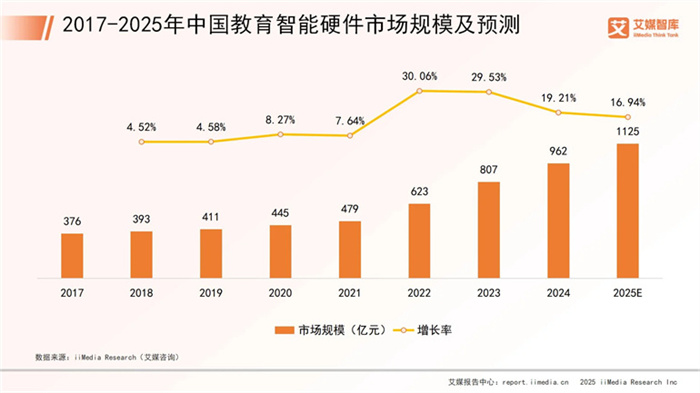
2017-2025年中國教育智能硬件市場規模及預測
數據顯示,2017-2024年中國教育智能硬件市場規模整體呈現上升趨勢,2024年中國教育智能硬件市場規模達962億元,同比增長19.21%。2022年開始,中國教育智能硬件市場規模增長率大幅度飆升。艾媒咨詢分析師認為,受“雙減”政策的影響,大部分線下教育輔導機構由線下教育變為線上教育,教育智能硬件設備成為傳統校外輔導的重要替代方案。
2025年中國智能硬件用戶對智能家居整體滿意度
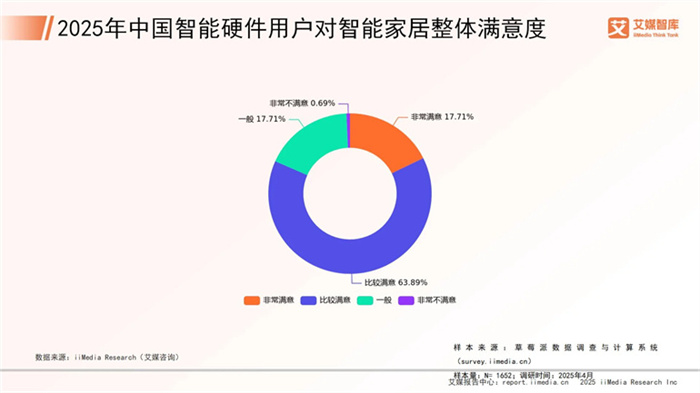
數據顯示,在2025年中國智能硬件用戶對智能家居整體滿意度調查中,滿意度最高的是“比較滿意”,占比達到63.89%,顯示出絕大多數智能硬件用戶對智能家居的滿意度較高。其次是“非常滿意”和“一般”,占比均為17.71%,表明有相當一部分智能硬件用戶對智能家居的滿意度處于中等水平。而“非常不滿意”的占比最低,僅為0.69%,說明大部分智能硬件用戶對智能家居的整體滿意度較高,極少數智能硬件用戶對智能家居的使用體驗感到不滿。
2025年中國智能硬件用戶接受的智能可穿戴設備類型
數據顯示,手表類智能可穿戴設備以51.69%的占比高居榜首,顯示出智能硬件用戶對手表類設備的高度接受度。手環類以43.07%的占比緊隨其后,表明手環也是受歡迎的穿戴方式。眼鏡類和服裝/鞋類分別以40.45%和35.96%的占比位列第三和第四,顯示出智能硬件用戶對這些穿戴方式也有一定的接受度。頭戴類和耳飾類分別以34.46%和30.34%的占比位列第五和第六。項鏈/戒指類和貼片類以28.84%和22.10%的占比排在最后兩位,說明這兩種穿戴方式的接受度相對較低。

2025年中國智能硬件用戶使用可穿戴設備的場景
數據顯示,在2025年中國智能硬件用戶使用可穿戴設備的場景調查中,支付與身份驗證(使用設備進行快捷支付等)和導航與定位(旅行中的路線指引等)的占比最高,均為47.19%。這兩個場景的高占比表明,智能硬件用戶對于可穿戴設備在支付安全性和提高出行便利性方面的需求強烈。遠程控制家居設備(通過智能手環控制家中的智能家電等)和健康情況檢測(睡眠呼吸、心率監測等)的占比均為44.94%,顯示出智能硬件用戶對智能家居控制和健康監測的高關注度。緊急救援(自動檢測異常情況并發送求救信號等)和環境監測(檢測空氣質量、溫度等)的占比分別為37.08%和36.33%,相對較低,但仍顯示出一定的市場需求。運動情況檢測也有34.08%的占比,顯示出智能硬件用戶對可穿戴設備的運動性能和運動時人體信息監測也有一定要求。休閑娛樂和工作需要的占比分別為25.84%和22.85%,相對較低,說明這些場景不是智能硬件用戶使用可穿戴設備的主要驅動因素。

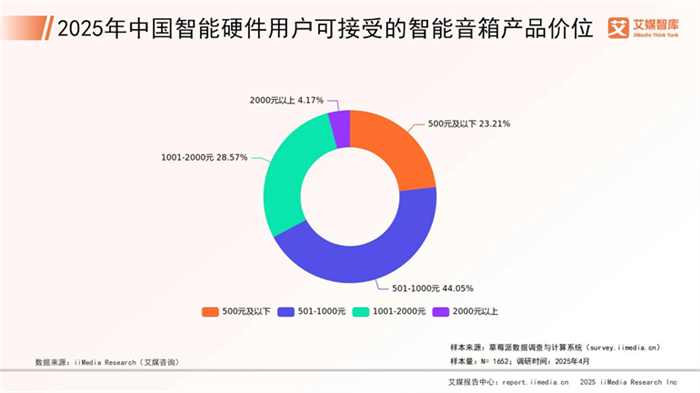
2025年中國智能硬件用戶可接受的智能音箱產品價位
數據顯示,在2025年中國智能硬件用戶可接受的智能音箱產品價位中,501-1000元的價位段占比最高,達到44.05%,顯示出智能硬件用戶對于中等價位智能音箱的偏好。其次是1001-2000元價位段,占比28.57%,反映出部分智能硬件用戶愿意為更高端的智能音箱支付更高的價格。500元及以下的產品占比為23.21%,說明仍有相當一部分智能硬件用戶對低價智能音箱保持興趣。而2000元以上的高端智能音箱接受度最低,僅占4.17%,表明大多數智能硬件用戶對于智能音箱的預算有限,更傾向于選擇性價比較高的產品。

行業資訊、企業動態、業界觀點、峰會活動可發送郵件至news#citmt.cn(把#換成@)。
海報生成中...


 鄂公網安備 42112402000149號